‘We won't kneel before the government to get our money back’ – Budapest mayor says
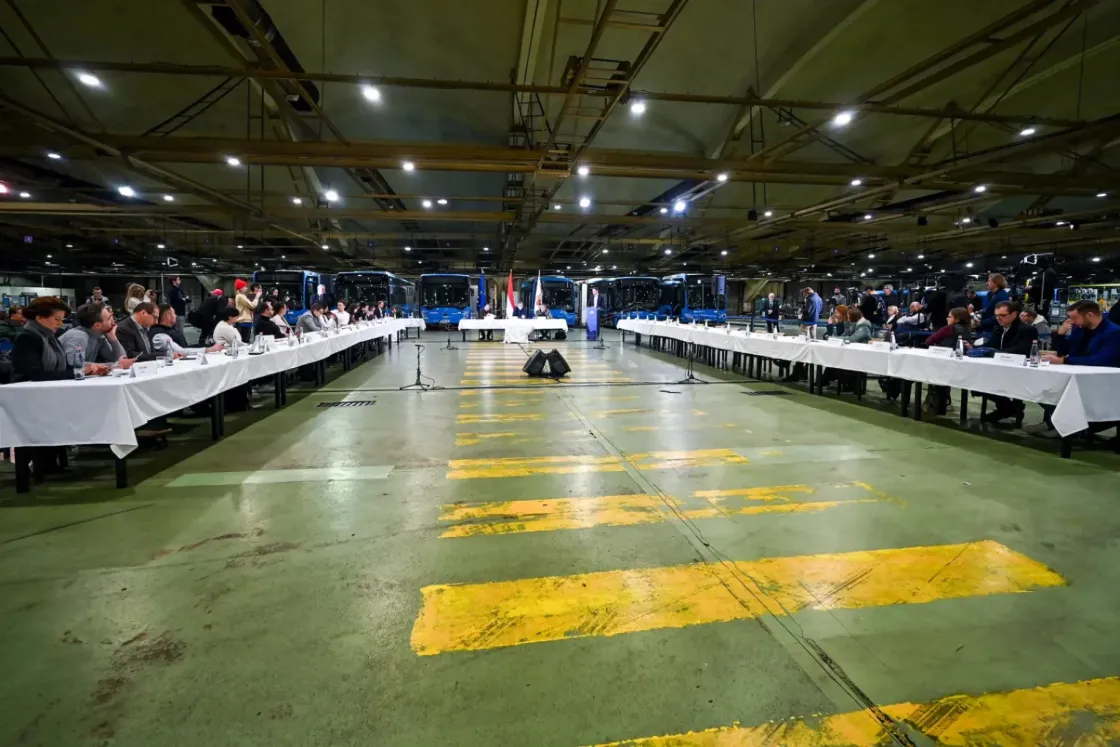

"We are not willing to destroy public services," Budapest mayor Gergely Karácsony said on Monday at the extraordinary meeting of the Budapest City Council at the Kelenföld bus depot, where the council was meeting to discuss the extremely difficult financial situation the Hungarian capital has found itself in. The mayor convened the assembly to the unusual location last week, following Minister Gergely Gulyás’s remarks that the capital should declare insolvency, after which the government would be prepared to provide assistance. Karácsony justified the unconventional location by saying that extraordinary times call for an extraordinary location.
And times are indeed extraordinary. For the past few years, the Hungarian capital has faced serious financial difficulties, but now the situation seems to be nearing a boiling point. It currently looks like the capital could close the year with a deficit of 33 billion forints which would result in an unlawful situation. According to law, it is illegal for a municipality to have a balance of anything other than zero or a positive one at the end of the year. If the year is closed with a deficit, the banks can automatically terminate Budapest's overdraft framework, which means that the city will neither be able to receive credit nor any revenue until next March.
Of course, this didn’t happen overnight. The opposition mayor and his team have been asking the government for help in various forms since early summer, but there has been no response whatsoever. Now, the mayor has stated several times that they can no longer hope in anyone except the government. Which speaks volumes in itself, given that for the past few years he has blamed the government for the city’s fiscal difficulties, while they, in turn, claim that it was Karácsony’s incompetent leadership that has led to this.

It was in the spring of 2023 that the mayor first warned that the city may face insolvency. According to him, this was because ever since he was elected, the Hungarian government has introduced several measures which have significantly reduced the capital’s income. Additionally, some laws were modified at record speed, to redirect various taxes or funds that were previously paid to the city – into the state budget. At the same time, the amount of the solidarity contribution the city is supposed to pay has been gradually increased. For comparison’s sake, in 2018, when the city was still led by a Fidesz politician, the capital had to pay 5 billion forints (a bit above 13 million euros) in solidarity contributions, but by 2023, the amount had been increased to 58 billion forints.
The Solidarity Contribution Tax was introduced in Hungary in 2012, with the purpose of ensuring that wealthier municipalities with higher revenues contribute to supporting poorer municipalities facing more difficult financial situations. The amount of the contribution is based on the tax revenues and other income of local governments. The higher their revenues, the higher the amount they have to pay into the central budget.
Additionally, as the mayor of Budapest pointed out, the state's financing of local governments has been reduced by 20 percent on average, while in the case of Budapest, by 30 percent.
In early summer, the capital’s leadership agreed to have the State Audit Office (ÁSZ) review the city’s operations, the results of which were published in September. The ÁSZ acknowledged that from 2020 onwards, in addition to the economic difficulties caused by the Covid-19 pandemic, the surge in energy prices and the rising inflation, the increased budgetary payment obligations imposed by the government also contributed to the capital's steadily worsening financial situation. The biggest burden among these is the solidarity contribution Karácsony has contested for years and which has gradually grown to 89 billion forints this year.
The report concluded that the capital was in "technical bankruptcy" and "insolvency was threatening the city’s ability to fulfill its public tasks."
Karácsony has also repeatedly pointed out how much money the government has failed to pay out to the city (for 2023 alone, this was estimated at HUF 148 billion). These were funds the state had previously committed to paying (a contribution to renovating the Chain Bridge, or buying new trolley buses for example). This year, things became more difficult when – on several occasions – the State Treasury simply collected funds (to be put towards the city’s solidarity contribution debt) from the capital’s account without any warning.
At Monday’s meeting of the City Council, Karácsony – among others – said:
“We will not kneel before the government and kiss their hands to get our money back."
Representatives of the Tisza Party did not attend the meeting, stating that they "will not bow to the government's blackmail." According to them, Budapest is not a bankrupt city, but a blackmailed one.
Tibor Déri of the Democratic Coalition (DK) opined that Budapest is not bankrupt, but has been pushed into bankruptcy.
"It is cynical to think that we should turn to the government that took the money of the people of Budapest in this way," Richárd Barabás, a representative of Párbeszéd said at the meeting.
The council adopted a document which includes a provision that the companies owned by the capital cannot be taken over by the state. In addition, they confirmed their decision from September acknowledging the report of the State Audit Office, which stated that Budapest could become insolvent by the end of the year.
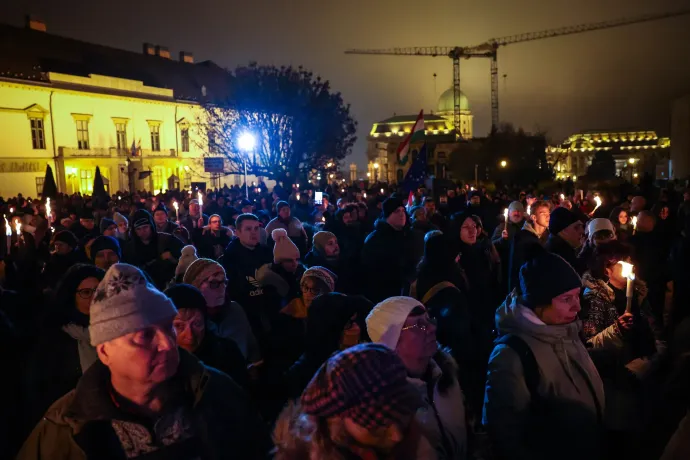
After the City Council meeting, the mayor met up with protesters at Clark Ádám Square. Before they walked to the Prime Minister’s office in the castle district, the mayor gave a short speech announcing: "We have accepted the decision that this city cannot be brought to its knees. Budapest must remain free, European, and united so that when the country is liberated from oppression, there will be a place to return to," he said.
Once the crowd arrived in front of the former Carmelite monastery which now houses the PM’s office, a woman came out and received the document about the City Council’s decision. The crowd then walked a bit further, where Gergely Karácsony gave a speech.
"I ask everyone to think about how their own family or household would be affected if, in the space of a few years, their landlord increased their rent twentyfold. Well, that is exactly what is happening in Budapest" – he said.
“This has been happening since the mayor has been someone who is not a member of Fidesz. In fact, this is happening because the mayor is not a member of Fidesz. The levy imposed on the city has been increased twentyfold."
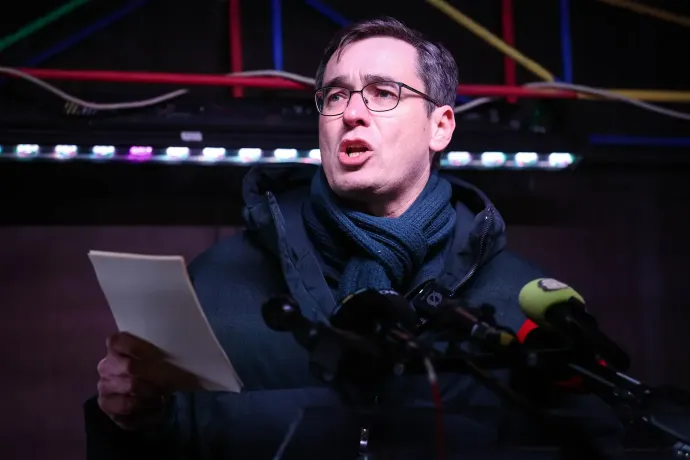
The mayor said that all they are asking is for "the Hungarian government to comply with Hungarian law." According to him, everything the state has laid its hands on in recent years has "rotted and deteriorated.” He brought up healthcare and the education system as examples.
He warned that if the 27,000 people working for Budapest do not receive their salaries in January, the city will come to a standstill, which will shake the entire country. The speech ended around 8:30 p.m., after which most of the protesters left the square in front of the Presidential Palace.
For more quick, accurate and impartial news from and about Hungary, subscribe to the Telex English newsletter!