If the Tisza Party wins, the president could be the stick in the spokes
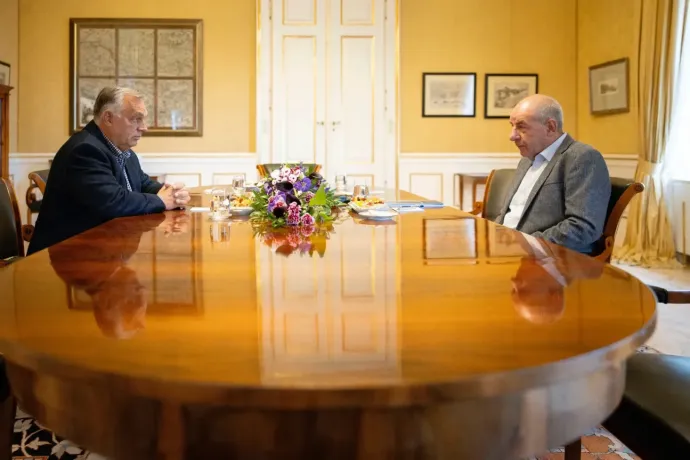


"This is further proof that Orbán's regime is terrified and that they too realise that the Orbán–Gyurcsány era will come to an end in 130 days," this was the response the Tisza Party sent to Telex when we asked them to comment on the amendment submitted in the Hungarian parliament on Thursday, which would essentially cement the position of the president.
Anonymous members of the ruling party submitted two amendments for Thursday's meeting of the parliament's legislative committee that would prevent parliament from temporarily declaring the president indisposed with a simple majority. The amendment would only become meaningful in the event of a change of government, as Tamás Sulyok, who was elected by Fidesz representatives, would have numerous means at his disposal to slow down or even obstruct the legislative process.
According to Hungary's Fundamental Law, the parliament has the authority to – at the initiative of the president, the government or any MP – temporarily declare the president indisposed by a simple majority vote. In such cases, his powers—such as signing laws and appointing officials—are exercised by the Speaker of the National Assembly, who is elected by a parliamentary majority at the beginning of each new term. If the Tisza Party were to win next April, their candidate would no doubt replace László Kövér in this position.
The ruling party's proposed amendment would change the current rules in two ways:
- the parliament's decision on the president's temporary inability to fulfill his duties must be approved by the Constitutional Court;
- instead of parliament, the president can make the decision to declare the stoppage of his indisposition.
In other words, the President of the Republic cannot be removed from office without the Constitutional Court (which is currently filled with Fidesz-delegated members), but, even if this were to somehow be achieved, he himself would decide on his return.
The legislation does not provide any examples for what being temporarily indisposed from performing duties means, but for example, a prolonged illness or other family circumstances could prevent the president from performing his duties.
Filling the legal loophole four months before elections
Fidesz's amendment will basically eliminate the supervisory function of the Parliament, Lóránt Horváth, president of the Lawyers' Association told 24.hu. "If the cessation of inability to perform the presidential duties is no longer determined by the Parliament, but by the president himself, then the president effectively decides for himself when he can return to power," said Horváth, who believes that limiting the role of Parliament would create opportunities for serious abuse.
According to the lawyer, in such a model, the declaration of indisposition, as well as its maintenance or termination could become a potential tool in political games and could result in a redistribution of power which could lead to an excessive autonomy of the president, the hollowing out of the parliament's control, and the possibility of the Constitutional Court slipping into a political role.
“I am glad that there is a law which states that the Prime Minister of Hungary thinks that they could lose the elections,”
opposition MP András Jámbor said at Thursday's meeting of the Legislative Committee.
The MP pointed out that in the past 15 years, Fidesz had never thought to address the issue of the president’s temporary indisposition, and now, four months before what promises to be a close election, they suddenly want to make changes to the rules. The circumstances themselves give cause for suspicion: they did not submit a separate bill, but slipped the amendments into two completely unrelated motions (amendments to public service laws and amendments to certain laws related to the Constitutional Court) submitted to the Legislative Committee just a few days ahead of the vote.
Gergely Arató called it indecent and unacceptable that four months before the election, the government would interfere with fundamental aspects of the power structure and the functioning of institutions. According to the DK representative, this has nothing to do with democracy and the system of checks and balances. “This is simply a power game, and it's unnecessary anyway. I don't think they will be able to prevent the will of the voters from prevailing with such legal tricks.”
"I would like to emphasize that this bill has no partisan political background whatsoever".
– Imre Vejkey, KDNP chairman of the legislative committee which drafted the bill about the constitutional court, said in response to the accusations. In his view, they are simply closing a legal loophole, as the detailed rules for temporary indisposition mentioned in the Fundamental Law have not been drawn up before.
Szabolcs Ágostházy, State Secretary of the Ministry of Public Administration and Regional Development, who submitted the legislative package on public service, made exactly the same argument at Thursday's committee meeting, saying that there were “no partisan political considerations behind the legislative intent.”
According to Fidesz MPs, the amendment is necessary because "if the establishment of the temporary indisposition should be erroneous and in violation of the Fundamental Law, it would lead to a significant disruption of public law in terms of the democratic functioning of the state," and only the President of the Republic himself can make an authoritative statement as to the ending of the temporary indisposition. The Parliament is scheduled to vote on the proposal on Wednesday.
A stick in the spokes, sand in the gears
Why it has suddenly become important for Fidesz to fill this legal loophole, and why they may want to – in the event of an election defeat – prevent the new parliamentary majority from sidelining the president from office by declaring him temporarily indisposed is an intriguing question.
Even with a two-thirds parliamentary majority, the Tisza Party would not be able to automatically remove Tamás Sulyok before his term expires. According to the law, impeachment proceedings can be initiated against the president if he deliberately violates the Fundamental Law or another law related to the exercising of his office. After a secret vote in parliament, the final word belongs to the Constitutional Court, which is filled with Fidesz members, so there is little chance that Tamás Sulyok could be removed before 2029 unless he resigns himself. However, temporary indisposition may be established by a simple majority – at least for the time being.
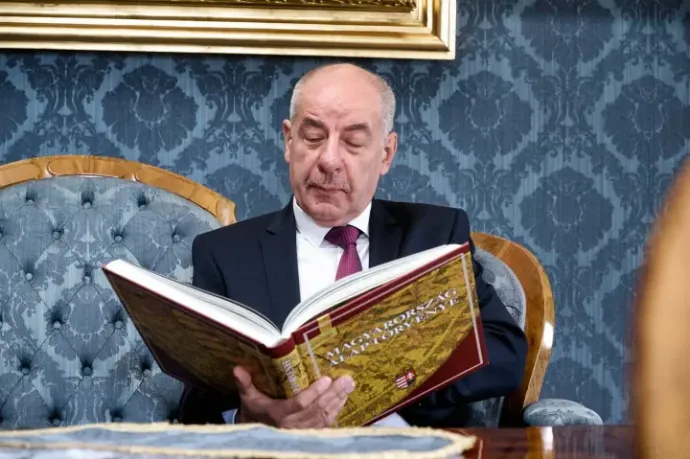
Under the current system, the Hungarian president mainly has ceremonial duties, but the Fundamental Law, which can be amended by a two-thirds majority,
provides him with several tools to slow down or even obstruct the work of parliament and the government.
The president is the one who convenes the inaugural session of Parliament and tasks the prime minister with forming a government. But what would happen if instead of asking the leader of the winning party to do so, he were to give the task to Fidesz's candidate for prime minister? Over the summer, the words of constitutional lawyer Zoltán Fleck, who addressed this scenario at a Tisza Party event were met with huge outrage from the government. According to Fleck, if a change of government is achieved in the current autocratic system, the leader of the opposition party that wins the election must put political pressure on the president to prevent this from happening.
The president is legally allowed to give the mandate for forming a government to the leader of the losing party, but ultimately, the prime minister and the government are elected by parliament. If the candidate proposed by the head of state is not approved by the body, he or she must propose someone else, but even then the law does not guarantee that the leader of the winning party will be the one asked to form a government. If parliament does not elect a prime minister within 40 days of the first nomination, the president may dissolve the body and call new elections, the Fundamental Law stipulates. As Fleck also pointed out, this would have unforeseeable consequences, so it is better not to even think about it. When Fleck brought this up, President Tamás Sulyok responded with an indignant Facebook post criticizing the ELTE professor's words. The President called on all political forces to “refrain from adopting and applying such views, which are deeply unconstitutional and violent, because otherwise they will exclude themselves from democratic discourse and the public order.”
More realistic than this scenario is that the president, who is closely aligned with Fidesz, will attempt to obstruct legislation after a change of government. Whoever wins against Fidesz will obviously want to introduce fundamental structural changes and, to this end, will want to push as many laws as possible through parliament as quickly as possible.
However, new laws only come into force after they have been signed by the president. The president has two ways of slowing down this process: through a constitutionality review and through the presidential veto. If the president finds a law to be contrary to the Fundamental Law, he or she can send it to the Constitutional Court for judicial review before signing it, and the court must make a decision within 30 days. If they find that it is contrary to the Fundamental Law, the proposal is returned to the National Assembly and must be renegotiated, which again takes weeks or months.
The President may also exercise his veto if he disagrees with a law. In this case, he may return it to parliament for reconsideration, which will debate it again and vote on it again, even in its unchanged form. The President of the Republic cannot veto the law a second time, but he can slow down the process by sending the adopted law to the Constitutional Court for review on the grounds of constitutional concerns. The body has 30 days to make a decision in this case too.
Since taking office in March last year, Tamás Sulyok has sent three laws back to parliament for reconsideration and has not yet requested a constitutional review, according to a response sent to our newspaper by the Sándor Palace.
However, after a change of government, the president could easily use these tools to slow down and complicate the legislative process, to the point where it could become politically dangerous for the new government.
In such a case, voters might get the impression that months after the new parliament has been formed, nothing has changed and all the new government is doing is fighting with the president. This is precisely why it may be important for Fidesz to ensure that, in case of a potential change of government, the president – whom they elected and whose ties to Fidesz would be difficult to dispute based on what we’ve seen over the past few years – cannot simply be sidelined.
Whether Tamás Sulyok would be capable of fulfilling the role outlined in this article and whether he could withstand pressure from the Tisza Party and the public is another question. There is another opinion as well, which Gergely Arató of the DK alluded to at Thursday's meeting of the committee. According to this view, it is possible that this amendment was not designed for Tamás Sulyok, but rather for a future, more agile president, who would be appointed by Fidesz's two-thirds majority before the election for a five-year term.
For more quick, accurate and impartial news from and about Hungary, subscribe to the Telex English newsletter!