Ziobro's asylum case may further damage already strained relations between Hungary and Poland



A politicized judicial system and the trampling of the rule of law vs. a cowardly politician who fled and may face charges – these are the two narratives dominating Polish news reports about former Polish prosecutor general and justice minister Zbigniew Ziobro having fled to Hungary, where he has been granted political asylum. Ziobro is a politician from the Law and Justice (PiS) party, an ally of the Hungarian government, which was forced into opposition in 2023, after having governed since 2015.
Szabolcs Panyi, an investigative journalist at VSquare reported in mid-December that Hungary may grant asylum to two more Polish citizens. The Polish press had already speculated at the time that this could be the former PiS minister and his wife. The Hungarian EU representation had informed the representations of all member states in a letter that it had granted asylum to two Polish citizens, but at the time, the Donald Tusk-led Polish government was not yet able to officially confirm the names of those involved.
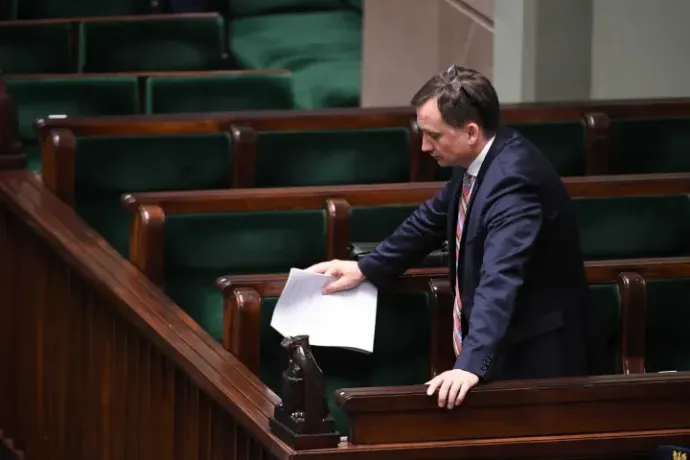
As Polsat reports, it was Ziobro himself who on Monday announced that he had been granted asylum in Hungary. The 55-year-old politician was a symbolic figure in the PiS governments, spearheading the judicial reforms that plunged the relationship of Warsaw and the EU into a serious crisis. As the AP recalled, the PiS-led coalition government, which was building an illiberal system, was determined to gain influence over important judicial institutions and appointments, placing friendly judges in the higher courts and initiating disciplinary proceedings against those critical of their government.
Before coming to power, Tusk's government promised to reverse these reforms, but in many cases, meaningful change has been made impossible by the fact that both the previous head of state and the current one are politicians close to PiS who have a right of veto. In a post on X, Tusk wrote that Ziobro was "the head of a corrupt political system" and that it was in this capacity that he sought political asylum from Viktor Orbán. "A logical choice," he added.
"Many people are being subjected to political persecution, and of course here in Hungary, if someone seeks asylum due to political persecution, we give it careful consideration and assess such applications in accordance with existing Hungarian and European Union legislation, said Foreign Minister Péter Szijjártó on Monday in response to Ziobro's case. According to him, "democracy and the rule of law are in crisis and under threat in Poland." Szijjártó also said that several people had been granted asylum, but he did not want to disclose any names due to those concerned being persecuted. In response to Ziobro's case, the opposition Tisza Party simply stated: “Under the Tisza government, Hungary will not be a place of refuge for foreign criminals.”
Bartosz T. Wieliński, deputy editor-in-chief of the liberal newspaper Gazeta Wyborcza, told Telex that retaliatory measures by the Tusk government over the asylum cases are quite conceivable. It is possible that the Minister of Foreign Affairs will declare the Hungarian ambassador, István Íjgyártó, persona non grata. If this happens, relations between Budapest and Warsaw, which are already at a low point, would worsen even more. Íjgyártó is already being boycotted by the Polish government and is regularly denied invitations to official events. According to Wieliński, the question is whether he will be "kindly asked to leave or kicked out."
What are the charges against Ziobro and his associates?
Ziobro has been charged with 26 criminal offenses, the most serious of which is establishing and leading a criminal organization. If convicted, he could face up to 25 years in prison. The main allegation is that he illegally withdrew money from the EU's Justice Fund, originally set up to compensate victims of crime, which he then funnelled to his allies. It is alleged that he may have embezzled as much as PLN 150 million (approximately 35,6 million euros). According to Szabolcs Panyi, the money was used to purchase the Israeli Pegasus spyware, which was then used to monitor individuals perceived as an inconvenience to Law and Justice.
Wieliński said that all 26 charges are related to the misuse of funds from the Justice Fund. The fund was established years ago with the purpose of helping victims of criminal offences. Among other things, the state has used such funds to help individuals who have been attacked, robbed, or subjected to violence but lack the financial resources to initiate civil proceedings against their attackers. The fund is financed by fines imposed on criminals and offenders.
During the 2015 parliamentary elections, Ziobro's small party, Suwerenna Polska (Sovereign Poland) which merged with PiS in 2024, ran on a joint list with PiS, but the main ruling party did not allocate any of its party funds to them. Ziobro and his colleagues therefore began to use the Justice Fund's money as their own. They financed events, sent money to local institutions, and bought cars for volunteer fire departments, all in districts where their politicians were running for office.
Wieliński also cited a case in which "a priest wanted to set up an institution for victims of criminal offences, for which he did receive money from the fund." In the end, they wanted to turn the project into a television and multimedia center that would have worked for Sovereign Poland, but the construction was not completed before the PiS-led government was replaced in 2023. The priest was later arrested in connection with the case. Many NGOs that were ideologically close to Ziobro's party also received money from the fund. According to the charges, the beneficiaries often had to channel some of the money back to the party.
Ziobro claims to be the victim of a political vendetta. Last November, he announced that he would only return home once the rule of law had been restored in Poland. According to his lawyer, Bartosz Lewandowski, he is willing to testify, but only in Hungary or Belgium, Notes from Poland reported. Lewandowski added that the prosecutor's office is aware that his client has two foreign addresses, so his testimony can be arranged through consular services or with international assistance.
According to TVN24, Lewandowski also said on Monday that Ziobro's international legal protection is based on the Geneva Convention. Under the 1951 document, refugees facing persecution can apply for a so-called Geneva passport, which allows them to cross national borders. He also said that on Thursday, January 15, the competent Polish court will rule on Ziobro's request for his preliminary arrest.
Regarding the first court hearing scheduled for Thursday, he said, "I hope that the Warsaw-Mokotów District Court will carefully examine the evidence presented by the prosecution, because I am convinced that there is no evidence of a crime having been committed." If the court approves the politician's arrest, they will appeal, he said.
On Monday, Ziobro requested international protection for his wife, who is apparently not with him in Budapest, so that she should be able to stay with their children. He claimed that the Tusk government wants to use Patrycja Kotecka as a hostage to force him to return home. He described the events as brutal aggression on the part of the government.
Ziobro used to live in Brussels for over a year because his wife had a job there. It's also been reported that the politician received treatment for an illness there. The former minister fled to Hungary in October, shortly before the Polish parliament (Sejm) voted to suspend his immunity, thereby allowing for his pre-trial detention. The Polish state first revoked Ziobro's diplomatic passport and then his regular passport as well, thus preventing him from leaving the Schengen area legally.
Hungarian Prime Minister Viktor Orbán posted a photo of himself with Ziobro at the end of October. Notes from Poland quoted Rzeczpospolita, which reported that Ziobro was likely making himself visible abroad to show that he was not in hiding, thereby attempting to avoid a European arrest warrant. Ziobro will therefore be able to make a statement in two ways: either at the Polish consulate in Budapest or Brussels or at the prosecutor's office of the country in question.
Everyone has an opinion
Polish Deputy Foreign Minister Ignacy Niemczycki said on Tuesday that the Hungarian ambassador in Warsaw had refused to provide any information about Ziobro's political asylum. "For me, this is strictly a political matter. It shows what kind of partner Hungary is in the EU," Niemczycki explained. The BBC noted that it is contrary to EU principles for one member state to grant asylum to a citizen of another member state. The British outlet adds though that this is neither new nor surprising in relation to Hungary.
According to the sources of WP Wiadomości, Ziobro will remain in Budapest until PiS returns to power. The next parliamentary elections will be held at the end of 2027, and PiS currently stands at 28 percent, while the ruling center-right Civic Coalition (KO) is leading with 34 percent.
Deputy Prime Minister Władysław Kosiniak-Kamysz said in November that Ziobro should be questioned in Poland, "not at a location designated by the person making the statement." Dariusz Joński, a pro-government politician, called Ziobro brazen, noting that in the end, he may even end up wanting to write the prosecutor's questions himself.
"The former justice minister, who is fleeing to avoid responsibility for his actions, went to a country where Viktor Orbán, a friend of Vladimir Putin, lives – everything is clear here. I think even to PiS voters," Cezary Tomczyk, deputy minister of national defense said. According to Tomczyk, what Ziobro and his colleagues are doing is “demoralizing the entire judicial system.” He called the PiS politician cowardly and weak, and rejected Lewandowski’s accusations that the judicial system had become politicized.
Włodzimierz Czarzasty, Speaker of the Sejm, said on Monday that Ziobro's remuneration would be investigated. Ziobro remains a member of parliament, despite his immunity having been suspended, but as he currently lives abroad, he is not participating in the work of the legislature in person.
Most of his party colleagues defended Ziobro. Mateusz Morawiecki, the former prime minister of PiS, said on RMF FM radio that Ziobro is being persecuted for political reasons and that Poland is somewhere between democracy and dictatorship. He argued that prosecuting political opponents is “characteristic of autocratic systems.” He does not know whether other Polish politicians will seek asylum in Hungary, and when asked if he would, he replied:
"I definitely am not going to seek asylum anywhere. Let them judge me here as they see fit. (...) I have stressed several times that, if necessary, I will appear where I need to, but I will follow the well-trodden path in my fight against this government."
Gazeta noted that accusations were brought against Morawiecki last February for exceeding his authority, which could result in a three-year prison sentence. The former prime minister did not testify and pleaded not guilty, and voluntarily waived his immunity. He is also under investigation for corruption charges related to the Government Agency for Strategic Reserves, but no charges have been brought in this case yet.
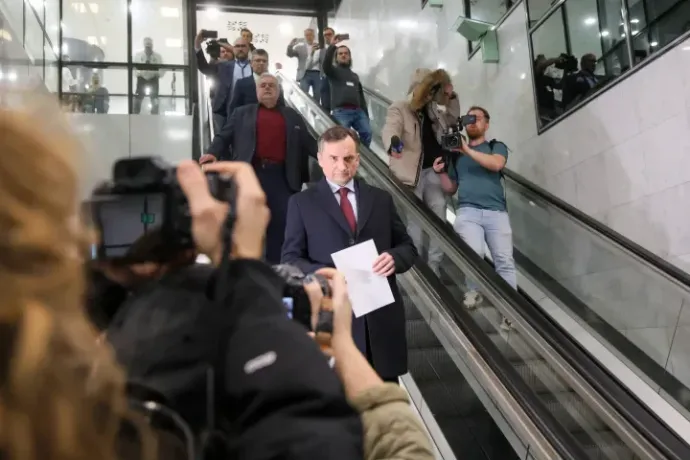
Today, solidarity with Zbigniew Ziobro means defending the principles of the rule of law, which must be upheld regardless of political affiliation," said Mariusz Błaszczak, leader of the PiS parliamentary group. According to him, one may only receive asylum of this kind from another country if it can be ascertained that they cannot expect a fair and impartial trial in their home country. Patryk Jaki, deputy leader of PiS is also among those defending his colleague, saying that the takeover of the prosecutor's office, the removal of judges who are inconvenient for the ruling parties, and the publication of judgments make this trial a manipulated one.
However, the newspaper also wrote that despite the party's official line being the need to defend Ziobro, not all politicians are enthusiastic about doing so. Some believe that they should focus on high prices, the collapse of the healthcare system, finances, and scandals involving the government.
Marcin Romanowski and his associates
Ziobro is not the first high-ranking Polish politician to be granted asylum in Hungary. Poland's former Deputy Minister of Justice Marcin Romanowski was brought to Hungary in December 2024 and granted political asylum after the prosecutor's office charged him with 11 criminal offences. Tusk's government was so outraged by the events that it recalled its ambassador accredited in Budapest to Warsaw, and according to information from last year, the accused politician now lives in Budapest's 1st district.
The Hungarian government even amended legislation to protect Romanowski, and was willing to risk making its already poor relations with the Polish government even worse. The Hungarian government's reasoning was that the Polish politician would not receive fair treatment in his home country. In early April last year, the Polish prosecutor's office issued a European red notice against Romanowski, but Interpol then refused to put him on the wanted list – and in keeping with the practice of the international police cooperation organization, did not disclose the reasons for its decision.
According to Szabolcs Panyi, Polish prosecutors are looking into who might have helped and assisted in hiding Romanowski at the time. "We are indeed investigating this line of inquiry as part of the main investigation into the Justice Fund case, which is being conducted by Investigation Team No. 2 of the Chief Prosecutor's Office. So far, we have not named any suspects. At this stage of the investigation, we are not disclosing any further details," a spokesperson for the Prosecutor General's Office said earlier.
Even Lech Wałęsa, the Nobel Peace laureate Polish politician spoke up about Romanowski's case last year. "This man is a thief, a criminal. He should turn himself in and stand trial. The relationship between the two nations was so good, it's a shame they ruined it," Wałęsa said. "Tell me where he is, I'll bring him home."
According to Bartosz Wieliński, Dariusz Matecki, a PiS MP may be considering fleeing Poland too, as he also used to distribute money from the Justice Fund to friendly NGOs. However, the deputy editor-in-chief added that the fugitives "have a problem in that Hungary is no longer such a safe haven," thus hinting at the possibility of a change of government after the upcoming elections.
Furthermore, with political asylum, the person concerned is "always dependent on the goodwill of their host." According to Wieliński, there is always some kind of agreement in the background; Viktor Orbán may also want to achieve something and may ask Tusk for something in return. "Ziobro is a loser, he has no future in Polish politics," the journalist said, citing a survey that found that only 8 percent of Poles sympathize with him, while 92 percent have a "totally negative attitude" toward him. PiS voters need a martyr, but Ziobro fled, and on top of that, he fled to a supporter of Vladimir Putin, so he can no longer become a martyr, he said, referring to the fact that, regardless of their political affiliation, Polish politicians are critical of the Russian president and his war in Ukraine.
Wieliński does not rule out the possibility of Ziobro fleeing even further, to Belarus, which is what Judge Tomasz Szmydt did in May 2024 and has been serving Belarusian propaganda ever since. Szmydt requested political asylum from Alexander Lukashenko's regime, citing alleged persecution in Poland.
For more quick, accurate and impartial news from and about Hungary, subscribe to the Telex English newsletter!