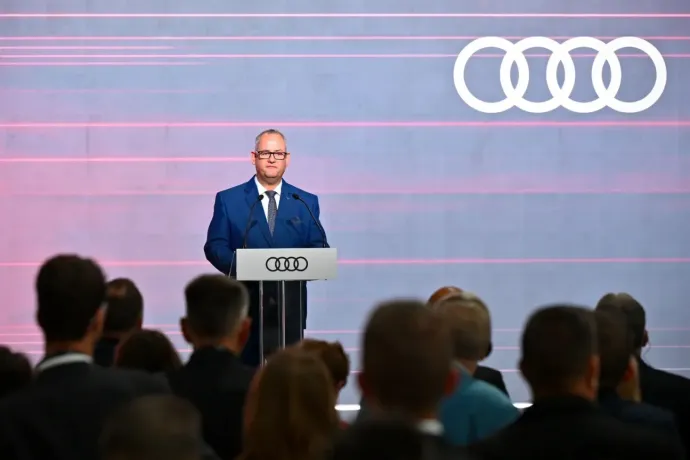


Győr-based Audi Hungaria is attributing its decision not to fill positions vacated due to staff turnover and retirement, or positions which are no longer needed, to its efforts towards boosting efficiency and competitiveness. Although no figures have been disclosed, Telex has learned that this decision could affect around 200 people in 2026, and
this time, most of the layoffs will affect engineers and office staff in areas indirectly supporting production.
Audi Győr's production figures for 2025 will be published as usual in March, but according to internal sources, the Hungarian plant will publish exceptionally good figures within the Volkswagen Group in both engine and vehicle production. The serial production of the third generation of the Audi Q3, combined with the Cupra Terramar has already foreshadowed a record year for the Győr plant, and the automotive plant is indeed operating at full capacity in three shifts, even though they share production of the Q3 with the Ingolstadt plant.
This is precisely why the "streamlining" announced within the factory now comes as a surprise, but the employees have by now been informed of the reasons behind it. In hindsight, Michael Breme, Chairman of the Board of Management of Audi Hungaria, had already hinted at what is currently happening last fall, but only a few people understood exactly what he meant back then.
In an interview with Telex at the time, he said that it was now, during the period of producing high volumes and operating at full capacity, that preparations for the future needed to be made. "In five years' time, it will be time to apply for the production of new vehicle models, and I would like Audi Hungaria to be able to take its place alongside the other applicants with its operations and structure fully optimised in every respect," Breme said four months ago.
The five years he mentioned in 2025 will be up in 2030, which is interesting in light of the fact that the current announcement is part of the "thirty-plus program" – at least that's how our sources within the factory have referred to the program from which they expect an improvement in competitiveness.
Last fall, the CEO of the Győr plant also referred to the competition within the group's Eastern European plants, from which Győr has so far emerged well, as it has been awarded the production of the two previously mentioned brands. As a result, a total of 770 vehicles are rolling off the production line at the factory every day, 60 percent of these being Audi Q3s and 40 percent being Cupra Terramars. However, these models will be phased out by 2030, and it is already clear that the Czech, Slovak, and Polish factories are lining up alongside the one in Győr, and their competitiveness indicators are currently "well on par with those of Győr," according to our sources.
For many years, Hungarian wages lagged behind those of other countries, but thanks to the strength of the 9,000-member trade union and their successful wage negotiations, the gap has closed and is now actually reversed. What's more, new wage negotiations are due this year, since the previous two-year agreement expires in 2026. It is already clear that wage negotiators are facing a much more difficult task this time around.
Moreover, it is not only production that is going to be affected by competition. In 2023, Audi Győr established a subsidiary that provides procurement, financial, and IT services to the group's companies. By now, there are also others offering similar services, and our sources with insight into the field consider the Poles to be the strongest and most dangerous challengers to Győr.
Everything we have listed so far is practically in line with the company's official response to our questions. Péter Lőre, Head of Corporate Communications and External Relations at Audi Hungaria, moved straight on to competitiveness after talking about the expected good figures for 2025. "The fundamental prerequisite for the company's future competitiveness is to further reduce our costs and optimize our processes and organizational structures. This is essential for winning new products and projects, especially in light of the strong competition with the group's other production capacities."
In response to our question about the positions affected, we were told that cost reduction and increasing efficiency would affect "both our production areas and the indirect areas and processes that support them." The company does not publish figures, because of Audi's internal rule that employees must first be offered other opportunities within the factory; and they only end up leaving if they do not accept these.
We saw an example of this last summer, when market demand went through significant fluctuation, resulting in less work at the engine plant, which freed up some employees and also had a negative impact on employment. Sources familiar with the situation confirmed to Telex that there were and still are changes within the factory: this mainly affected workers in the engine factory who worked on the production of the V6 Otto engine, the R4 gasoline engine, as well as the diesel R4 TDI. Dozens of them did not accept the offered transfer – mostly to the vehicle factory – but the vehicle factory still does offer continued employment to all employees who are made redundant at the engine factory.
A similar situation may be expected now, but it is difficult to imagine an engineer or office worker who would be willing to work multiple shifts, just as workers who had been working at the engine factory for decades and are now approaching retirement were not happy about being transferred to vehicle manufacturing, which involves greater physical exertion.
According to the latest data available to us, Audi Hungaria currently employs 650-700 engineers in technical development, while Audi Hungaria Ahead Kft. employs approximately 500 office staff. Based on the latest data available from September 2025, Audi has 11,626 employees in Győr. This number is slowly but steadily declining.
Audi's operations play a significant role in everyday life in Győr:
- The more than 11,000 employees represent just as many families in the region, and with suppliers included, we are talking about the livelihood of 50,000 people being secured by the automotive industry.
- Several engineering courses at Győr's Széchenyi István University are built around Audi (there is a separate department for Audi Hungaria), so it is also important for them to know how many intellectual workers the company will need.
- Audi's business tax provides the basis of the city's revenue.
- And, among other things, the local construction industry has also been able to count on Audi employees with secure incomes.
For more quick, accurate and impartial news from and about Hungary, subscribe to the Telex English newsletter!