“He held us hostage for a long time”—Orbán’s EU colleagues bid him farewell at EU summit he skipped
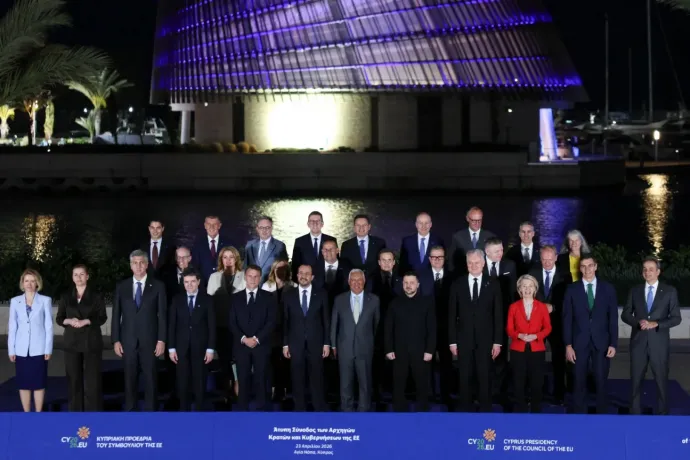

“Viktor Orbán held us hostage for a long time. That is now over,” Estonian Prime Minister Kristen Michal said in Agia Napa, Cyprus, upon arriving for the EU summit of heads of state and government that began on Thursday—a summit his Hungarian counterpart did not attend.
Similarly to other leaders, Michal was pleased that they were able to unanimously adopt the new sanctions package that day, as well as the legislation needed for Ukraine’s €90 billion loan—the latter of which was blocked solely by the Hungarian government, while the former was blocked jointly by Hungary and Slovakia.
A unanimous agreement on the loan had been reached back in December, stipulating that it would not impose a financial burden on three countries, including Hungary; however, in February, the Hungarian government blocked the adoption of the amendment to the joint budget guaranteeing the loan, pending the resumption of oil transit through Ukraine on the Friendship pipeline. As a result, following the most recent EU summit in March, Viktor Orbán was accused of unlawful blackmail, and the overwhelming majority of member state leaders condemned his stance.
March turned out to be the last time Orbán attended one of these meetings before the new government took office, because in the wake of his election defeat, he chose not to attend Thursday’s EU summit, citing the handover process; however, both decisions were finalized just hours before the meeting began.
“In December, the leaders of three countries opted out and one—Viktor Orbán—held us hostage for a long time,” Kristen Michal summarized the story. According to the Estonian prime minister,
“the message of the Hungarian election was felt all over Europe, and that message was that it is not wise to fight against a united and capable Europe doing things.”
“Every member state had their challenges,” Irish Prime Minister Micheál Martin replied with a smile when asked about Viktor Orbán. “The good news” is that the obstruction has passed. “In our view, Viktor was unreasonable, to put it mildly,” on numerous issues, not just regarding Ukraine. “I think it will be easier in that regard, but there are always challenges with 27 member states.”
Obviously, when there is less resistance on certain issues, it is good for Europe to speak with one voice, Luxembourg’s Prime Minister Luc Frieden said when asked if he expects a more unified EU without his former Hungarian counterpart.
“We’ll have to wait and see,” the host, Nikos Christodoulidis said when asked what changes he expects without Orbán.
“I think there’s a little bit too much euphoria about Viktor not being” at European Council meetings anymore, Bart De Wever said diplomatically, whose party belongs to the Eurosceptic ECR. “In my experience—I’ve been here for a year and a half—he was often a difficult partner, but never impossible.” He believes that
“it may be an exaggerated to say that his way of thinking” exists only in Hungary, “we'll find out in the next few months,”
“perhaps some things will become possible with Ukraine that have been very difficult so far”— he said, referring to the fact that it won’t necessarily be easy to agree on everything with Péter Magyar either.
Lithuanian Prime Minister Gitanas Nausėda urged similar caution, saying that “there will always be things we will approach differently”, but “at least now I see the possibility that the European Union’s voting mechanism will not be abused, and that the leadership of one country will not hold the other 26 hostage.”
“If there is good will, yes, we can debate, our opinions may differ, but ultimately we will always find a solution and reach a decision.” In his view, “it was truly a shame to see this paralyzed decision-making, which made Europe appear ‘less credible and weaker’ in the eyes of the international community, and it is not in our interest for Europe to be weaker. It is in our interest for Europe to be stronger.”
For more quick, accurate and impartial news from and about Hungary, subscribe to the Telex English newsletter!