Péter Magyar clearly willing to engage in confrontation Orbán tried hard to avoid


“This would suggest that the Slovak government is prepared to further escalate the situation and has no intention of backing down even the slightest bit,” Zoltán Szalay, editor-in-chief of the Hungarian news portal Napunk in Slovakia, told Telex, commenting on statements made by Slovak Deputy Prime Minister Robert Kaliňák about the Beneš decrees. In his view, all of this suggests that “they will continue to exploit anti-Hungarian themes during next year’s election campaign.”
Speaking about the Beneš Decrees, Kaliňák, a member of Prime Minister Robert Fico’s Smer (Direction) party, first stated on public radio on Thursday that this was not a matter of land confiscation, but rather that the Slovak Land Fund was simply claiming property that had rightfully belonged to it since 1945. Shortly thereafter, in parliament, he said that the Slovak Land Fund was not confiscating anything, it was merely establishing the state’s existing ownership rights rather than acquiring new property under the Beneš Decrees. According to his explanation, the problem stems from the fact that the records were inaccurate during the socialist era, so a lot of state-owned land was not properly registered. Then, after 1989, using “abusive” procedures, many people unlawfully acquired land which actually belonged to the state, which the authorities did not always monitor adequately.
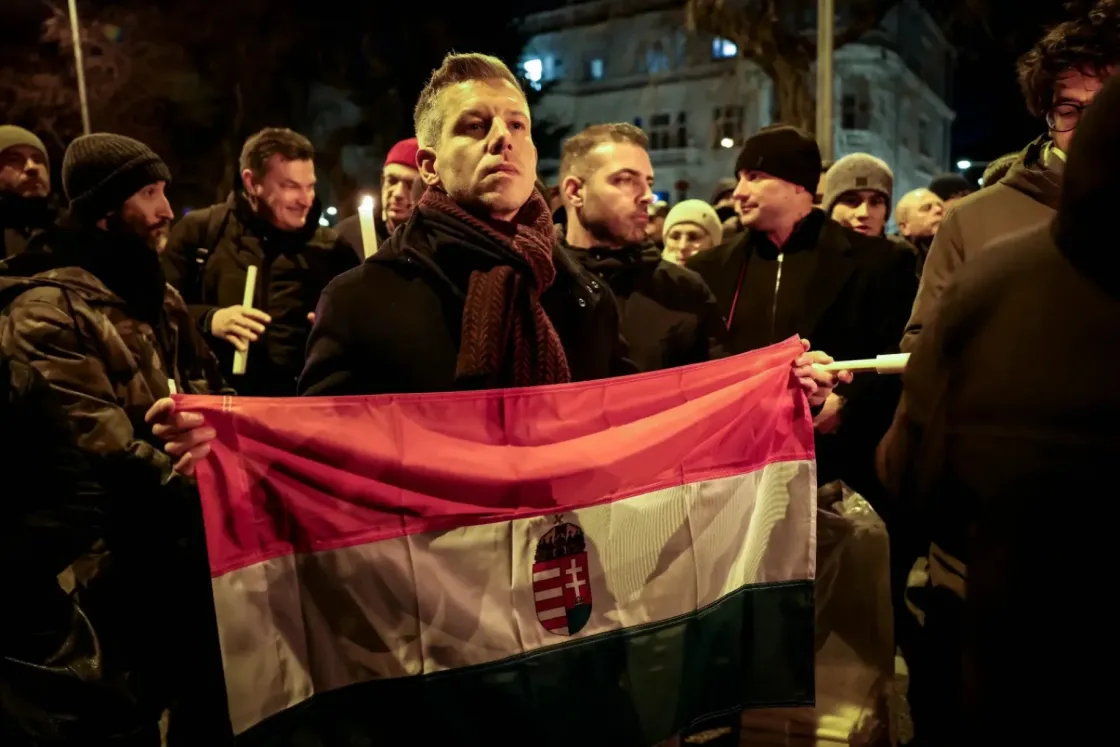
While the Orbán government—which has been quick to loudly protest in other international matters—tried to avoid open confrontation on the European stage with Fico, whom they consider an ally, even during the election campaign, Péter Magyar promised that if the Tisza Party came to power, it would respond with the strongest possible diplomatic measure to the new Slovak legislation which has been threatening ethnic Hungarians in Slovakia with imprisonment since the end of last year.
“I have just had a phone call with Slovak Prime Minister Robert Fico. I made it clear to him that we can only discuss any policy issues once we have received a guarantee that Slovakia will repeal the legislation threatening the Hungarians living there with imprisonment, and if they commit to ensuring that in the future, the lands of our fellow Hungarians will not be expropriated under the Beneš Decrees, a law based on collective guilt,” he wrote about his first phone conversation with Fico a week and a half after Tisza’s landslide election victory. Magyar also said that he intends to bring up the issue with the Slovak Prime Minister in person at his first EU summit; commenting on the phone call, Fico, however, said that they hold fundamentally different positions on the Beneš Decrees.
Although, according to their statements, both the future Hungarian and the Slovak Prime Minister intend to work on strengthening Hungarian-Slovak relations, it remains to be seen how this work can begin as long as the issue of the Beneš Decrees remains unsettled. The incoming Hungarian foreign minister and deputy prime minister, Anita Orbán has also identified this as her most important task during the first 100 days of the Tisza government.
A serious situation
At the end of last year, an increasingly intense political debate unfolded in Slovakia about the Beneš decrees and the land expropriations carried out based on the legal grounds they provided, an issue that particularly affected the Hungarian community. This stems from the principle of collective responsibility—applied to Germans and Hungarians—at the end of World War II. Certain decrees, which were issued at the time, and were elevated to the status of law, allowed for the deprivation of rights and property of individuals belonging to these ethnic groups who were deemed de jure responsible for the war.
Although the legislation about expropriation dates back to the Beneš Decrees, it was the émigré Slovak National Council that issued the corresponding regulations at the end of the war based on these decrees. In many cases, however, the expropriations weren't carried out. Now, many decades later, the Slovak state essentially wants to continue this practice, citing the fact that not all affected land was expropriated due to previous administrative errors.
The debate escalated to the point where, in December, Fico’s government passed a law stipulating, among other things, that questioning the Beneš Decrees would be punishable by imprisonment. Under these decrees, Germans and Hungarians are held collectively responsible for World War II. On December 23, Slovak Prime Minister Peter Pellegrini signed the relevant amendment to the Criminal Code, which, among other things, makes it a criminal offense to influence an election campaign by a “foreign power” and to publicly deny the above detailed post-World War II settlement.
Prime Minister Viktor Orbán firmly rejected the Beneš Decrees, but remained cautious when it came to the steps to be taken. He only said that he had already brought up the issue with Fico, but still needed to "gain more insight" into the matter. Gergely Gulyás, Minister in charge of the Prime Minister’s Office, stated at the end of December that the government condemns the principle of collective guilt. One of the arguments they brought up in relation to the new Slovak law was that it hadn’t been applied against anyone yet, so there was nothing to protest against. Later, Gulyás also said that Slovakia is pursuing an incorrect and misguided policy on the Beneš decrees, and that a line had been crossed, so “we can even count on European human rights forums.” The Hungarian government promised legal assistance to anyone disadvantaged by the decrees and sent an open letter to the President of the European Commission concerning the matter.
From the outset, Magyar strongly condemned the law and stated that in this situation he would expel the Slovak ambassador. Finally, in the first week of January, he wrote an open letter to Fico, leaving space at the bottom for Viktor Orbán’s signature alongside his own. In the letter, he asked the Slovak Prime Minister to withdraw the amendment and “make room for dialogue, which can serve as the basis for peaceful coexistence.” Magyar even openly clashed with Slovak President Peter Pellegrini. Meanwhile, he highlighted a contradiction between the Orbán government’s rhetoric and its actions on a sensitive issue: while their statements about matters affecting ethnic Hungarians living in neighbouring countries have generally been bold, their response to this specific case was far more passive.
Szalay has now said that the amendment to the criminal code about the questioning of the decrees is before the Slovak Constitutional Court. Several petitions have been filed, with the opposition and the public prosecutor’s office also having turned to the Constitutional Court on the matter, but the law remains in force. However, there are no known ongoing criminal proceedings related to this issue. Although several activists reported themselves to the police at the beginning of the year, the police halted the proceedings. The European Parliament has addressed the matter on several occasions; there have been committee hearings, and it was also debated in the plenary session.
Land expropriation disputes, however, have continued, and some new cases have even emerged. Lawyers recently identified plots of land near Bratislava where a bicycle path was built using EU funds. They have therefore called on the European Commission to launch proceedings against Slovakia, as EU money is involved in this controversial matter.
According to Szalay, the fact that Péter Magyar did not back down on the matter of the Beneš Decrees after the elections—and in fact stood firmly against them even following his victory—elicited very positive reactions from Hungarians in Slovakia.
In his opinion, “the issue is not going to go away,” and Magyar’s position could keep it alive. “We expect there to be tension between the two sides,” because Fico is not going to make concessions.
“It would be difficult for him to back down from this position; doing so would create uncertainty among his own voters,” the editor said. It is unclear how Magyar could persuade Fico to make any concessions, so the relationship between them may grow even more frosty—and Kaliňák’s repeated statements about the application of the decrees have only added fuel to the fire.
Cautious confusion
“Viktor Orbán’s defeat took the Slovak government by surprise; it seemed they weren’t prepared for this,” said Zoltán Szalay about the reaction to the Hungarian election. No one in Slovakia questioned the results, but those close to Prime Minister Robert Fico tried to interpret them in a way that suited them. Some representatives of the main ruling party, Smer, claimed that
the Slovak opposition has no reason to rejoice over Péter Magyar’s victory, because Magyar is not a liberal, “but a young Orbán.”
It is already clear that, among neighboring countries, Slovakia will be the most interesting arena for Péter Magyar’s new foreign policy. After all, Fico was one of Viktor Orbán’s most important allies in the European Union, despite the fact that his nominally social-democratic party did not join the Patriots for Europe party family. Fico also pursues a pro-Russian policy, he has visited Moscow, and has made combative statements about Ukraine's energy policy. Moreover, Péter Magyar already clashed with Fico during the Hungarian election campaign, partly over the application of the Beneš Decrees, and partly because of Fico's closeness to Orbán. The Slovak Prime Minister ended up congratulating Magyar; after which the two spoke on the phone and agreed that there were several things on which they do not agree.
With regard to the Hungarian election, some pro-government opinions suggest that Viktor Orbán’s departure from power would not be favourable for Slovakia. “Still, the Slovak government is handling these opinions very cautiously,” and they have not been critical of Péter Magyar, according to Szalay. During the campaign, Fico made remarks suggesting that Magyar was a ‘Brussels politician’—but he is now more diplomatic, and “there have been no outbursts.”
According to Szalay, there was another skirmish after Péter Magyar claimed in an interview with Válasz Online that when there were proceedings underway against Fico, and the parliament came extremely close to revoking his immunity, there were Hungarian government vehicles waiting for Fico at the border to evacuate him should his immunity have been revoked. “This caused quite a stir among the Slovak public,” which is why Fico criticized Magyar at the time, calling him a pro-Brussels activist.
Meanwhile, “cautious optimism has been emerging” among the Slovak opposition, but there has also been a great deal of debate about what lessons Slovakia can learn from the Hungarian election results. The main point of the debate is whether Slovak opposition parties should unite if they want to win the parliamentary elections scheduled for 2027. Progressive Slovakia, which leads in the polls, is pushing for this, but the smaller Freedom and Solidarity (SaS) and the Christian Democratic Movement (KDH) oppose it and insist on running separately.
According to Szalay, the rising Slovak far right also tried to downplay the Hungarian government change. Their narrative is that the outcome cannot be called a defeat for conservative forces, because Péter Magyar also considers himself a conservative. The main force of the far right, the increasingly powerful Republika, is closer to Mi Hazánk, according to the editor; with a connection already in place between party leaders Milan Uhrík and László Toroczkai.
A broken stick between the spokes
Analysts largely agree that Slovak-Hungarian relations could deteriorate significantly in the future, said Zoltán Szalay. What existed under Viktor Orbán is over, as can be seen in relation to the Beneš decrees. It is unclear whether things could again become as tense as they were in the 2000s will return, because “the two countries have very close economic and cultural ties.”
A qualitative change in relations can also be expected given the differences in Fico’s and Magyar’s mentalities. For Fico, however, putting the Hungarian issue back on the agenda is an obvious opportunity in this situation. Having lost Orbán as one of his main pillars of support, “he can once again play the Hungarian card in his politics.” All of this also depends on the extent to which Orbán will remain a factor in international politics despite his downfall.
“Fico will likely remain the EU’s most pro-Russian politician,” although the Bulgarian election results—last Sunday’s victory of Rumen Radev’s party, which is said to be pro-Russian—could change that. Fico is again planning to attend the Victory Day celebrations in Moscow on May 9 this year—although the Baltic states are not allowing him to fly over their airspace—which he also did last year, drawing plenty of criticism for it. According to Szalay, Fico’s good relationship with Putin will remain intact even after Orbán’s defeat.
Although they have often found common ground on sanctions lists and energy issues, the Slovak Prime Minister has not always supported Orbán within the EU on issues such as vetoes and obstructions, preferring instead to offer him verbal support while often siding with the remaining 26 member states. According to Szalay, Fico is expected to be much more pragmatic on these issues. He has backed down many times because the Commission warned that EU funds could be at risk if he got involved in the disputes, and the Slovak economy is struggling, so the country needs these resources.
He may be able to move together with Czech Prime Minister Andrej Babiš on issues where responsibility can somehow be shifted, such as the €90 billion loan intended for Ukraine, from which the Czechs, Slovaks, and Hungarians opted out, but the commitments of the other member states have been approved.
Stunned Hungarian minority
As early as the end of last year, on account of the Beneš Decrees, the Hungarian Alliance started moving closer to the opposition party Progressive Slovakia. Party chairman László Gubík “maintains very close ties with Fidesz,” but he did not get involved in the Hungarian election campaign. Péter Pandy, chairman of the National Council, participated in some Fidesz campaign events, but according to Szalay, he is not an influential politician.
Gubík stated that they have no connection whatsoever with Tisza, even though pre-election polls indicated a shift in the mood of Hungarian voters. After the elections, he told Napunk that he attended Fidesz's election night gathering in Budapest. “This really blew the fuse with the Slovak opposition,” but according to Szalay, Gubík is unlikely to lose his position, as “the situation hasn’t escalated that far” within the party.
Gubík is expected to meet with Péter Magyar in the coming days. “This is a period of cautious positioning,” Gubík has indicated that Magyar’s communication about the Beneš Decrees aligns with the Alliance’s position. With regard to subsidies, Magyar said they will retroactively investigate the use of funds which have been sent to the Hungarian organizations in neighbouring countries and will look into any potential past abuses. “The Hungarian Alliance is neck-deep in this, and skeletons may end up coming out of the closet.” According to Szalay, finances provided by the Bethlen Gábor Fund were managed without any transparency whatsoever, which could bring up some sensitive issues.
As for what the Hungarian community in Slovakia thought of the election results, Zoltán Szalay pointed to a public opinion poll conducted by Napunk–Ipsos ahead of the vote. According to its findings, the majority of Hungarians in Slovakia favored Fidesz, but the pro-Tisza camp was also significant: the ratio was 46 to 36 percent. The number of Fidesz supporters was higher among the backers of the Hungarian Alliance.
“Some were disappointed while others were confused,” and the intelligentsia and the youth welcomed Tisza’s victory.
“Obviously, there are fears, especially with regard to subsidies,” said Szalay when asked whether Hungarians in Slovakia were apprehensive about Tisza’s victory. Some have spoken and written about subsidies not being withdrawn immediately during a Tisza government. However, some individuals close to the Alliance and its inner circle are fearful. “And the same applies to those who have enjoyed the benefits of the system”—organizations that have received large sums of money through political lobbyists are also concerned about the anticipated changes to the subsidy system. There have been suspicions that some organizations were secretly channeling party subsidies to the Alliance, and previously to the MKP (Hungarian Coalition Party). The question now is, what will become of these organizations without this funding?
For more quick, accurate and impartial news from and about Hungary, subscribe to the Telex English newsletter!