From the golden toilet to the golden convoy: How Ukraine, fighting for survival, became Hungary’s primary adversary
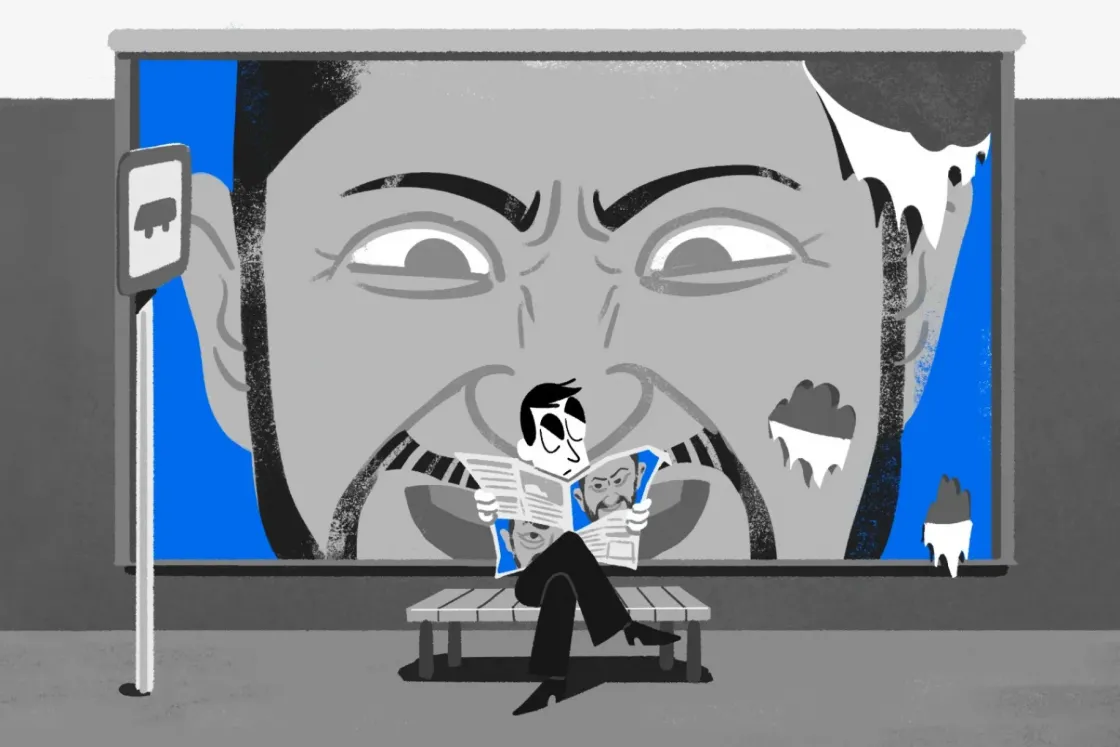

Over the past few years, an unsuspecting foreigner visiting Hungary might have believed that Volodymyr Zelensky was also running in the 2026 parliamentary elections: they would have been confronted with an astonishing number of hate-mongering billboards depicting the Ukrainian president in various compromising situations, unflattering images, and with defamatory captions. The lowest point was undoubtedly the "golden toilet" billboard by the company of Megafon's István Kovács, which showed Zelensky, Péter Magyar, and European Commission President Ursula von der Leyen standing around a toilet made of gold, with the caption: "They raise taxes and spend your money on a golden toilet." Russian disinformation networks did not spare us either, but Hungary was unique in that the ruling party willingly and enthusiastically assisted in these operations. Thus, Russians didn't have to work very hard to steer the propaganda in a direction that suited their tastes. Over time, the eyes and minds of Hungarians grew accustomed to this situation, and everyone learned to live surrounded by the staggering volume of anti-Ukraine disinformation.
In recent years, Fidesz spent astonishingly high amounts to convince us that Ukraine – a country at war, fighting for its very survival – is essentially the devil incarnate, the greatest threat to Hungary and the European Union, and that even the then-ruling party's biggest opponent, the Tisza Party (which has since won the election), is under its thumb. This hate campaign was arguably unparalleled in Europe, if not the entire world. However, it ultimately failed to achieve its goal, and past a certain point, the Hungarian public could no longer be provoked by an AI-generated Zelensky staring diabolically into the camera.
Yet precisely because this type of campaign was such a uniquely Hungarian phenomenon, it is worth exploring how Ukraine became Hungary's primary adversary in recent years, and what pre-existing tensions Fidesz exploited to construct and maximize this narrative, only to ultimately fail because of it.
As early as 2014, Hungary wasn't a fan of Russian sanctions
The first signs of anti-Ukraine disinformation appeared during the Russian-Ukrainian war, though tensions between Hungary and its neighbor had already been brewing long before then. On July 3, 2012, the Ukrainian parliament passed a new language law stipulating that Ukrainian is the sole state language of Ukraine. Under a 1999 ruling by the Ukrainian Constitutional Court, this also meant that Ukrainian became the only official language in the country. The situation escalated significantly in 2017, when the Ukrainian parliament passed the new education law, followed by the 2019 state language law built upon it. The latter made the use of the Ukrainian language mandatory in almost all areas of life.
This law served as the actual legal and political foundation on which subsequent political campaigns and disinformation operations were based.
It is noticeable, however, that even as early as 2014, the Hungarian government was not particularly accommodating toward Ukraine. "In 2014, following the invasion of Crimea, Viktor Orbán already stated on Kossuth Radio's '180 Minutes' program that we had shot ourselves in the foot with the sanctions against Russia," director of Political Capital, Péter Krekó, told Telex. “It is clear that a rhetorical campaign by the Hungarian government regarding the sanctions had already begun back then, but the government unequivocally condemned the annexation of Crimea, and between 2014 and 2017, the relationship between Hungary and Ukraine, although not entirely free of tension, remained on a normal bilateral footing. Then, starting in 2017 with the passing of the education law, the government's rhetoric became increasingly and openly hostile toward Ukraine, which progressively pitted it against both the EU and later NATO.”
According to the expert, this is not a chicken-and-egg scenario: both foreign and domestic political considerations simultaneously played a role in Ukraine increasingly emerging as the primary adversary. "As for domestic political aspects, polls indicated that Ukraine was one of the most unpopular countries among the Hungarian public, while in terms of foreign policy, however, as Orbán's relations with Moscow warmed, Hungary increasingly became a servant of Russian interests within the European Union. Meanwhile, Hungary, which was blocking Ukraine's accession to the EU due to conflicts over language use, served as a very useful tool for Russia," said Péter Krekó.
In 2022, the outbreak of the Russian-Ukrainian war came at just the right time for Fidesz, allowing it to build an entire election campaign around the "war or peace" slogan, accusing the opposition of being pro-war. At that time, people perceived the war raging next door as a real and immediate danger, and the relativization of the Russian attack and the demonization of Ukrainians increasingly appeared in the Hungarian public sphere. Initially, Hungarian state channels reported on the events relatively objectively in parts of their news broadcasts, but in their news analysis programs, they disseminated Russian narratives without hesitation. Thus, while there was a central, largely pro-Ukraine narrative from the ruling political elite and objective reporting was present in pro-government media, the transmission of pro-Kremlin, anti-Ukraine narratives was "outsourced" to experts and opinion leaders associated with Fidesz.
Georg Spöttle, a prominent figure in state media programs, compared Zelensky to Hitler as early as February of that year, while in March, Fidesz MP Gyula Budai concluded that, in the midst of the Russian-Ukrainian war, it was Zelensky’s resolute goal to interfere in the Hungarian elections. Fidesz influencer Philip Rákay lashed out at the Ukrainian president in a relatively lengthy post, in which he stated, among other things, that his message to Zelensky and media networks was: "leave my country alone." In May 2022, Tamás Lánczi, the future head of the Sovereignty Protection Office was already repeating Russian narratives on the state media's "48 Minutes" program. By 2022, Politico was already writing about Hungary as the EU capital of Russian disinformation.
The method worked for Fidesz, and there is no better proof of this than their electoral victory that year. Later, in his victory speech on April 3, Viktor Orbán explicitly stated that Zelensky was an opponent of Fidesz. In 2022, however, we did not yet see the classic anti-Ukraine campaign, but rather security- and fear-based narratives, where the emphasis was on the opposition parties being pro-war. That year, Péter Szijjártó, the Minister of Foreign Affairs and Trade at the time, even supported granting EU candidate status to Ukraine.
By this time, however, Russian disinformation narratives had increasingly taken over the ruling party's communication: according to Péter Krekó, these included claims that Ukraine had essentially provoked the war; that Zelensky is a poor leader, an actor, and a puppet of Western nations; that there are Western biolabs operating in Ukraine; and that the British gave nuclear weapons to Ukraine – while they themselves are developing their own nuclear arsenal. "A significant portion of these statements are Russian narratives originating from Moscow, and Viktor Orbán repeated them multiple times on live broadcasts. For example, he stoked fears that a nuclear war would break out just a few kilometers from the Hungarian border," the expert noted. Yet numerous other examples can be found where the government adopted specific narratives verbatim from Russia, slightly adapting them to Hungary's context. And the 2022 election confirmed to Viktor Orbán that this approach works. “The Hungarian government was swept into this narrative universe partly by pro-Russian foreign policy and partly by the inertia of its anti-Brussels and anti-Ukraine domestic politics – a universe that, in hindsight, is increasingly clear to have been a dead end.”
Hungary becomes one of Russia's European strongholds for disinformation and intelligence
While Russian disinformation was pushed to the periphery in most Central and Western European countries, especially after the EU banned the Russian state channels RT and Sputnik, something unique happened in Hungary. The pro-government media holding, public media, and the Megafon network adopted these Russian talking points without criticism and tailored them to their domestic election campaign. This is how, for instance, the Russian claim that "NATO and the West want to drag the region into the war" became "the left would send Hungarian soldiers to the slaughterhouse" in the Hungarian campaign; and how the Russian narrative that "Kyiv is involved in secret international conspiracies" circulated through the Hungarian pro-government media as a fake news story claiming that “Zelensky and the Hungarian opposition signed a secret pact.”
The government was already railing against the sanctions on Russia at this point: the streets were flooded with billboards reading "Peace Requires Strength" and "Brussels' Sanctions Are Ruining Us." On billboards promoting the national consultation at the time, sanctions were depicted as a bomb – even though the Hungarian government had voted in favor of every single sanctions package up to that point. At one point, however, "war-induced inflation" became "sanctions-induced inflation" in the Orbán government’s narrative.
Then, in 2023, the government shifted tactics, and instead of Ukraine, the EU's sanctions against Russia became the primary enemy: Brussels was blamed for the economic hardships. During this phase, Ukraine was presented not as demonized but as an economic burden. Later, however, narratives intensified claiming that the neighboring country was corrupt, suffered from neo-Nazi problems, and that Zelensky was constantly making demands.
Meanwhile, a website called Orosz Hírek (Russian News) broadcasted Russian propaganda without criticism, including material from the banned RT (Russia Today), and the pro-government press adopted information from it without hesitation. For example, in 2023, Magyar Hírlap published foreign policy articles based on this anonymously-run website more than 1,500 times.
In early 2023, new national consultation billboards appeared; the government plastered the country with the slogan "Hungarians have decided: 97% NO to sanctions." In reality, it was not 97 percent of all Hungarians who said no to the sanctions in the national consultation, as the survey was only filled out by a total of 1.4 million people. Admittedly, among them, the "no" votes did achieve an overwhelming victory.
At the time, it appeared that the ruling party succeeded in convincing its own voters of all this: every third Fidesz voter believed that the war broke out because of Ukraine. Only 10 percent of those voting for the ruling party held Russia responsible for the outbreak of the Russian-Ukrainian war, and one in four pro-government supporters believed the US was to blame. Among the general population, however, a completely different picture of responsibility emerged: the majority of Hungarians blamed Russia (40 percent), while only 17 percent held Ukraine responsible.
Our reputation in the wider world was significantly worse: by 2023, not only was Politico labeling us as the stronghold of Russian fake news, but the European Parliament's special committee on foreign interference also adopted a report identifying Hungary as a European bridgehead and staging ground for Russian disinformation activities and intelligence.
At the end of 2023, a spectacular turn occurred in the narratives: Orbán began campaigning against Ukraine's EU accession.
The interests of Hungarian farmers were brought to the forefront, claiming they needed protection from cheap, genetically modified Ukrainian grain, while government propaganda asserted that Brussels wanted to force its own will upon us. This led to the appearance of "Let's not dance to their tune" national consultation billboards on the streets featuring Alex Soros and Ursula von der Leyen. The majority of public tenders for these and the following years' consultation billboards were won by the companies of Gyula Balásy, NER’s favorite communications figure – who, following the government change in April, gave a tearful interview on Kontroll. His companies subsequently managed to establish a monopoly in a relatively short period of time. Balásy owes most of his fortune to these campaigns, which by 2025 was estimated at 79 billion forints.
By the autumn of 2023, they had already begun blurring the lines between Brussels and Ukraine. For a time, the leading narrative was that Hungary was not receiving the funds withheld due to the rule-of-law procedure because Brussels was sending them to Ukraine, meaning Zelensky was taking Hungarians' money. Viktor Orbán reiterated this during his summer speech in Tusnádfürdő. Balázs Orbán, the prime minister’s political director, went so far as to subtly blackmail the Ukrainian president, telling Bloomberg that Hungary would support Ukraine's EU accession only if it received its EU funds. "My impression here was that these were just pretexts," Péter Krekó said. "It is often said that the Hungarian government exports domestic politics abroad. Here, I saw the exact opposite happening: it brought its foreign policy into Hungary.
Then came 2024, the time for the European Parliament elections, and with it, the new Fidesz campaign: Ukraine's European integration remained one of the main topics, along with the narrative that Brussels supports it all, and that only Viktor Orbán can protect Hungarians from this external threat. The logic and rhetoric of the campaign closely resembled what was seen during the 2015 refugee crisis, elevating the Ukraine issue into a systemic political campaign. From July 1, Hungary held the rotating presidency of the European Union, and Viktor Orbán immediately visited Ukraine, then Russia, the Turkic Council meeting in Nagorno-Karabakh, and China. During the press conference following their meeting, Vladimir Putin stated that, in his view, Orbán was there representing the EU presidency, an assertion the Hungarian prime minister did not refute on the spot. The European Council later condemned the “peace mission.”
The rise of the new “pro-war opposition”
Soon, however, an enemy emerged on the scene who – as it turned out – proved to be far more dangerous to the Orbán government: Péter Magyar. When the current prime minister burst onto the scene in February 2024, the ruling party's communication machine applied the previously well-tested "pro-war left" template verbatim to Péter Magyar as well. Vans plastered with billboards showing pro-war politicians sitting in Russian tanks toured the country courtesy of the Civil Unity Forum (CÖF), while early in the year, another influence campaign masquerading as a national consultation was carried out; billboards announcing its results informed us that 99 percent of respondents rejected Ukrainian grain, weapons shipments, migrant ghettos, and gender propaganda. It is another matter, of course, that this time too, only a fraction of eligible voters filled out these questionnaires.
The intense combined Russian-Hungarian disinformation unleashed on the public had its effect: by 2024, the acceptance of Russian conspiracy theories within domestic public opinion was exceptionally high, even in regional comparison. A joint researchby three Central European disinformation analysis hubs, HDMO, CEDMO, and BROD, revealed that skepticism toward facts and objective reality was alarmingly high in all examined countries. Hungary, however, was particularly affected, fueled by a deep distrust of the media. More than two-thirds of the population doubted the credibility of the facts presented to them, a climate highly conducive to the spread of disinformation. The research also showed that "Ukraine fatigue" was strongly present in the region, with Hungarians being the least in favor of providing military support for Ukraine (10 percent). Non-military support was slightly more popular, but even so, it remained a minority opinion. Support for increasing sanctions against Russia was also in the minority, and Hungarians supported this the least as well. The same research also helped highlight why Russian narratives worked so well in Hungary: political polarization is exceptionally high in Hungary, so both pro-government and opposition voters tended to confine themselves to "opinion bubbles" that matched their political views.
In 2025, Viktor Orbán again repeatedly stated that Hungary does not support Ukraine's accession to the European Union. At one point he even said: if Ukraine were an EU member, it would "ruin Hungary and put our children's lives in danger." In March, he was the sole EU leader who vetoed the joint EU resolution supporting Ukraine, thereby becoming increasingly isolated with his anti-Ukraine stance. By June, he was already communicating with Zelensky on social media by stating that
"Hungarians do not want to die for Ukraine," and “we do not want our children coming back from the front in coffins, or Hungarian money going to Ukraine.”
In December, speaking about the war, he said: it is not clear who attacked whom.
At that time, courtesy of the National Resistance Movement (Nemzeti Ellenállás Mozgalom-NEM) – the group also responsible for the golden toilet campaign – billboards depicted Ursula von der Leyen, Romulusz Ruszin-Szendi, Péter Magyar, and Volodymyr Zelensky, who was embracing him, working together for the war. The billboard was also put up near schools on several occasions. But the communication also took a completely different direction: NEM also released a video claiming that Péter Magyar and Volodymyr Zelensky are similar in many ways, and at the end of the clip, both are swept up onto a dustpan like little pieces of trash. Billboards were then created based on this comparison, featuring Magyar and Zelensky as two newly hatched chicks.
Meanwhile, the propaganda media stepped up their efforts; Telex even prepared an analysis on how many times Zelensky received a figurative 'slap' in their headlines. Articles appeared here with headlines such as "Orbán’s move a slap to Zelensky he won’t quickly recover from," or "A massive slap to Zelensky and Péter Magyar! Recent research shows what people think about Ukraine's EU accession," or “Von der Leyen and Zelensky receive huge slap from Hungarian voters.”
A Hungarian girl mourns her dead father in a war-themed news broadcast
Although the campaign was already well underway in 2025, the situation escalated drastically in 2026: during Viktor Orbán's final months in power, an even tougher, openly anti-Ukraine rhetoric dominated Fidesz’s communication. In early 2026, the prime minister made Ukraine one of the central themes of the election campaign.
As for political narratives at home, Orbán reheated the main messages of the 2022 election: only Fidesz can keep Hungary out of the war, the opposition and Brussels would drag Hungary into the conflict, and Ukraine's EU membership would pose a direct threat to the country. Only the intensity changed: it felt as though more billboards, propaganda videos, and propaganda articles than ever before were blaring this message. By February, the former prime minister explicitly stated that Ukraine is our enemy. At the March 15 national holiday celebration, there was little mention of the 1848 war of independence, but plenty of party politics: Orbán went so far as to say that we must choose who should form a government: him or Zelensky. A key theme became that if Fidesz did not win the election, young Hungarian men would be drafted into the war. A memorable moment of this was an AI-generated video in which a little girl waits in vain for her father to come home, only for him to be shot at the front, but surely burned into the minds of every Hungarian is also when the anchor of the public news service deliveredpropaganda news amidst a war-themed set design.
Meanwhile, utterly improbable disinformation campaigns also appeared: NewsGuard, an international fact-checking and disinformation research organization, found at least 34 coordinated TikTok accounts that used professional deepfake videos to smear Péter Magyar and support Viktor Orbán by mimicking the voices and faces of, for example, Leonardo DiCaprio or Johnny Depp. By then, European security experts had long been warning that Russia might attempt to interfere in the elections, since Orbán was a reliable ally for Putin within the EU. Researchers dubbed this type of disinformation "slopaganda," which can be effective because although voters often know the video in question is not real, the eye-catching, absurd format still allows the content to reach millions and plant the political message in their minds. These networks generated more than ten million views before the election.
As the election approached, experts began hinting that Viktor Orbán might be preparing a "self-inflicted attack," that is, a false flag operation (deliberately attributed to someone else) that Fidesz could use as a pretext to postpone the vote. Regarding the explosives found near the oil pipeline in Serbia, several analysts suggested that the ruling party may have intended it for this purpose. National security expert and former senior intelligence officer Péter Buda, for instance, wrote that based on leaked information, certain circles had already known about a planned false flag operation against critical infrastructure with Hungarian interests on the Serbian side of the border. If that indeed was the goal, it was rather ineffective: the Serbs quickly stated that they found no traces indicating Ukrainian involvement near the pipeline.
Although the self-inflicted attack ultimately did not happen, on March 5 the conflict with Ukraine culminated in a highly unusual operation: a police car with flashing lights overtook and pulled over two vans of Ukrainian cash-in-transit couriers traveling from Austria to Ukraine at the Alacska rest stop near Budapest. The shipment, later dubbed the "golden convoy" in pro-government media, was traveling from Raiffeisen Bank in Austria toward the Ukrainian headquarters of Oschadbank along a transit route the Hungarian police was familiar with. Operatives of the Counter Terrorism Centre were already waiting for the Ukrainians, fully armed, at the Alacska rest stop. The 27 billion forints' worth of cash and investment gold found in the vans was seized by the National Tax and Customs Administration, while the Ukrainian couriers were released hours later and expelled from the country.
Government communications implied that the Ukrainians were transporting the money and gold illegally, whereas Kyiv maintained that Hungary had simply robbed the Ukrainians' money. A statement by János Lázár at the time aligned with the latter, when he said, "we don't know who sent this cash or why, but we aren't giving it back." Lázár made these comments after Viktor Orbán decreed that Ukraine would certainly not receive its gold and money back for two months, and that the assets thus acquired would remain under the supervision of Hungarian authorities until the investigation was concluded. Telex held conversations with sources close to or involved in the matter, who stated that the government, and specifically Viktor Orbán had ordered the operation, and it is presumed that he intended to blackmail the Ukrainians into reopening the Druzhba oil pipeline, which had been damaged in a Russian attack at the end of January.
The Russian project named Matryoshka also became increasingly active in 2026. This is a disinformation operation that mass-disseminates fake news through a coordinated network of bots, trolls, and anonymous profiles. Its goal is to create artificial information noise and manipulate the perception of events both within Russia and abroad. These fake news stories involving Hungary aimed to demonize Ukraine and indirectly support the pro-Russian Orbán. A campaign regarding an alleged assassination and coup attempt against Viktor Orbán was even launched before the elections: these fake news stories spread primarily on X, claiming, for instance, that a Ukrainian refugee, Denys Nikolaichuk, had been arrested in France for allegedly planning to throw a homemade grenade onto the grounds of the Hungarian embassy in Paris. Then Matryoshka struck again, once more exploiting the Hungarian-Ukrainian tension: one fake news story, for example, ran with the Reuters logo and claimed that Zelensky told Politico that only backward people could elect and support Viktor Orbán.
After the election, Lakmusz reported that, according to a study, for over a month leading up to election day, various pro-Fidesz media outlets, influencers, and channels close to Russia disseminated the "Hungarian Maidan" narrative: the claim that the Hungarian opposition, with Kyiv's support, was preparing demonstrations modeled after the 2014 events in Ukraine, which were expected to escalate into violence. A search for the term "Maidan" in the disinformation database of the European Union's EUvsDisinfo project yields more than 900 hits, most of which are linked to Russian sources.
This narrative, of course, was once again not a Hungarian invention: since the original Maidan, Russia and its allies worldwide have branded every event that goes against the Kremlin's interests in this manner, whether it concerned protests in Belarus, Serbia, or Georgia. An examination of the various manifestations of the "Maidan narrative" reveals a clear pattern: any dissatisfaction with a pro-Russian government, or any protest against Russian influence or interference is deemed an action artificially instigated by external forces.
The image of an omnipotent Russia is itself disinformation
Internal security teams at social platforms were themselves forced to intervene in the final stretch of the Hungarian election. TikTok launched an Election Center to assist users with reliable information about the elections and take action against misinformation and manipulation. The company also cooperated with international fact-checking partners, employed Hungarian-speaking moderators, labeled AI-generated content (recognizing AI content created on other platforms as well), and used verification labels for content and accounts. Content that placed false endorsements into the mouths of public figures or depicted them as perpetrators or victims of harassment or abuse was classified as prohibited content. Furthermore, the platform designated the majority of newspapers published by the pro-Fidesz Mediaworks and Mandiner (published by MCC, an educational institution with very close ties to Fidesz) as Hungarian state-controlled media.
"Many things came to light during the election campaign that I think we already knew, but it ultimately proved that the Hungarian government was acting in Russia's interest," said Péter Krekó.
"GRU, that is, Russia's military intelligence agency; the FIS, i.e. Russia's foreign intelligence service; and the SDA, namely the Social Design Agency, also partially activated themselves. There was a very strong collusion between Hungarian and Russian politics, and the Russians tried to do as much as possible to ensure that the election ended with Orbán's victory."
According to the expert, the 2026 election results show that Russia can actually be quite unsuccessful in boosting its own candidates. “I think it is time to realize that Russia, just as on the Ukrainian front, is often weaker in hybrid warfare than it appears. This does not mean the threat should not be taken seriously, but the image of an omnipotent Russia is itself a hybrid warfare disinformation product that has little to do with reality.”
The election results also show that by 2026, something shifted in society, and people could no longer be manipulated by narratives that had barely changed since 2022. According to a Political Capital survey published before the election, a significant portion of respondents feared electoral fraud and perceived the threat of foreign influence, while AI-manipulated content appearing during the campaign caused growing confusion in the public sphere. Voters were less receptive to Fidesz's political myths than what we had been accustomed to, and far more people feared Russian influence than Ukrainian. Nearly half of the respondents (48 percent) agreed that Russia wanted to influence the elections. They expected the same far less from other actors: only about a quarter of respondents anticipated election interference from Ukraine, the United States, or European Union institutions.
"Let there be no doubt that the Russian disinformation hybrid warfare threat will not disappear overnight. We can already see articles appearing in pro-Russian and Fidesz-aligned media claiming that Péter Magyar made a pact with the Ukrainians and represents the interests of the Ukrainian secret service, and that the protective shield around Hungary during the Orbán era has now vanished. The narrative now looks as follows: because the new government is so pro-Ukrainian, a kind of legitimate self-defense is essentially arising on Russia's part once again. Fundamentally, I expect a disinformation vacuum to form now, because domestic disinformation outlets are disintegrating and losing their relevance right before our eyes. However, more foreign and among them Russian disinformation will likely find its way into this vacuum," said Péter Krekó.
He believes that in the future, hybrid threats should be expected instead, an instance of which may have been the recent drone attack in Transcarpathia. "This is hybrid in that it is a tool of hybrid warfare against the Hungarian state; the Russians' goal is to demonstrate that the new government is incapable of protecting Hungarian-speaking citizens across the border," Krekó said. He added that we can also expect narratives to intensify in areas where the Russians have previously been less active in Hungary, such as anti-vaccine sentiment—where they might even find a new ally after Fidesz in the third parliamentary party, Mi Hazánk.
The Hungarian domestic politics of the past few years certainly demonstrate well that modern disinformation rarely relies on entirely fabricated stories. Instead, it builds on real political conflicts, societal fears, and existing grievances. The situation of Transcarpathian Hungarians, the Ukrainian language laws, or the Russian-Ukrainian war were all topics upon which it was easy to construct emotionally resonant narratives. During the election campaign, these stories appeared simultaneously across social media, propaganda outlets, and foreign influence operations, frequently reinforcing the same messages. This clearly shows that contemporary disinformation is not necessarily about persuasion, but often about amplifying fears and increasing social division.
How can you protect yourself against it?
Since modern disinformation typically magnifies or distorts real events or social tensions and places them into an overly emotionally charged narrative, recognizing manipulation often depends not on whether a claim is completely false, but on the purpose and context in which it is disseminated.
According to experts, it is worth being suspicious if:
- the same message appears simultaneously across multiple platforms from different actors as a coordinated campaign (a Hungarian example being when the same "pro-war opposition" message appears simultaneously on billboards, in news broadcasts, and with social media influencers);
- the message seeks to polarize, meaning to amplify the most extreme viewpoints while suppressing moderate or nuanced opinions (a Hungarian example: the "war or peace" type of framing, where the pro-peace position belongs to Fidesz, and everything else is pro-war);
- the emotional charge is exceptionally strong, as disinformation campaigns frequently build on fear or outrage (a Hungarian example being the disturbing video in which the little girl waits in vain for her father to return from the front);
- the message exploits confirmation bias, meaning it reinforces our pre-existing prejudices and opinions (such as the "Ukraine is taking Hungarians' money" narrative, which builds on a pre-existing distrust);
- the context is manipulated or entirely missing;
- the claims cannot be verified, being based on anonymous sources or exclusively on leaked documents (for example, Index's articles on the Tisza's tax plan);
- the same visual or narrative element becomes a recurring symbol in political messages (a Hungarian example: joint billboards of the "Zelensky-Péter Magyar-Brussels" type, which merge different actors into a single image of the enemy).
This article was produced with the support of Free Press for Eastern Europe, within the framework of the Science+ program.