Paks nuclear plant may be shut down due to record-low water level of Danube, PM announces
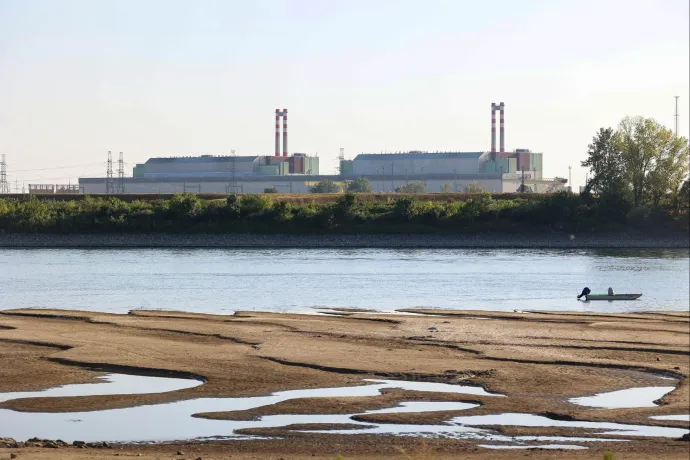

Due to low water levels in the Danube, the Paks Nuclear Power Plant may need to be fully shut down on Thursday or Friday, Prime Minister Péter Magyar said on Thursday in Budapest at a press conference held jointly with the Bavarian Minister-President Markus Söder, according to MTI.
The announcement comes as similarly to most of Europe, Hungary finds itself battling yet another brutal heatwave, with the drought of course taking a toll on the lakes and rivers of the country as well, the Danube being no exception. Its water level has in recently continued to drop, reaching a new historic low in Budapest this week. As of early Thursday morning, the water level at Paks measured at -121 centimeters. Due to this, the nuclear power plant announced that they had begun reducing the operating capacity of Unit 2 by fifty percent. The announcement followed the one from the day before that Unit 3 would be completely shut down due to the low level of water.
The Prime Minister has previously said that Hungary's electricity supply would remain secure even if the Paks nuclear power plant had to be shut down, because the country is able to import between 3,600–3,800 MW of electricity.
Update:
The Paks Nuclear Power Plant was not prepared for such an extremely low water level of the Danube, Antal Kovács, the plant’s communications director said to Telex. The Paks Nuclear Power Plant issued a statement on Thursday saying that, according to their estimates, the plant would have to be completely shut down within three days at most due to the record-low water level of the river. The statement explained that the shutdown was necessary because water from the Danube is used to cool the plant.
“This has never before happened in the history of the nuclear power plant”, the communications director said. When it was designed, the plant was built to withstand water levels well below the record lows of the past hundred years on the Danube; this has been sufficient until now, but “we were not prepared for levels like this.” Antal Kovács emphasized that the Paks Nuclear Power Plant is otherwise generally very reliable and is designed to even withstand earthquakes. He noted that the NPP currently accounts for generating just under half of Hungary’s electricity. He was unable to provide information on exactly which Hungarian power plants could make up for the loss of output resulting from the shutdown of the Paks plant.
Difficult days ahead
Effective Thursday through next Tuesday, the Hungarian Surgeon General has issued a level-three heat alert effective from Thursday through next Tuesday. During those days, the highest temperature is expected to remain between 36-37 degrees Celsius, with the daily average expected to stay around 27 in some parts of the country.
Minister of Economy and Energy István Kapitány announced on Thursday that he is consulting with experts on the security of the country’s energy supply. “...The country’s most qualified energy experts are sitting down together today to ensure that every decision is made in a timely, fully coordinated manner, based on sound professional data", he wrote on Facebook, promising to keep the public informed.
Due to the extreme drought, Minister for the Living Environment László Gajdos has previously ordered an extraordinary level of readiness in sixty-six of the country’s eighty-four water scarcity management districts. “This means that experts from the Water Management Authority will carry out drought relief measures at the highest alert level across 74 percent of the country,” he said.
As the heat continues to intensify, local authorities started distributing bottled water at the busiest train and bus stations across the country and drinking fountains have also been set up at several locations, according to MTI.
Don’t go walking inside the dry riverbed, authorities warn
“Some of the newly exposed sections of the riverbed are part of the bank-filtered water sources that provide drinking water to the more than two million residents of Budapest and its metropolitan area. These water sources are vulnerable and constitute a critical part of the infrastructure that needs to be especially protected,” the Budapest Waterworks (Fővárosi Vízművek) announced on Facebook in response to “recent press reports” of people venturing inside the dry, recently exposed sections of the Danube. They noted that there are in fact laws which prohibit people from entering or lingering in the sections of the Danube riverbed which belong to the protected drinking water source areas.
Although the company did not specifically mention any particular news story, we also reported on Wednesday that there is so little water in the Danube, that it is actually possible to ride a bike from Budapest to Vác inside the dry riverbed.
The article was updated after publication to include the statement of the Paks NPP's communications director.
For more quick, accurate and impartial news from and about Hungary, subscribe to the Telex English newsletter!