Mol expects first shipments of crude oil on reopened Friendship pipeline to arrive in Hungary on Thursday
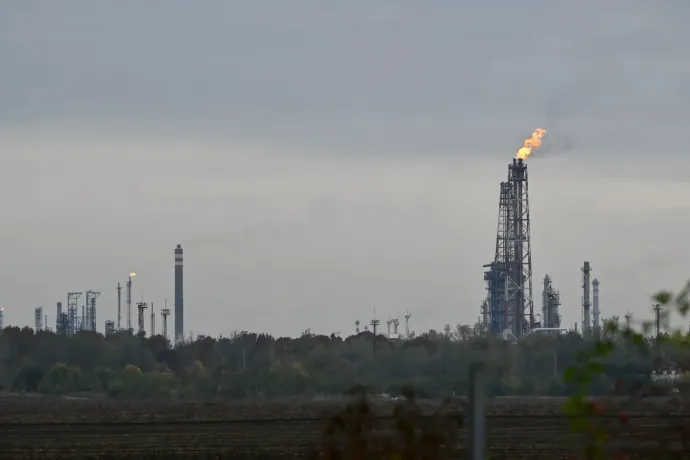


Hungary's oil giant, Mol Nyrt. published an important announcement on April 22 on the website of the Budapest Stock Exchange.
In it, the company stated that
“JSC Ukrtransnafta, the operator responsible for the Ukrainian section of the Druzhba pipeline has officially informed Mol that repair work on the Druzhba pipeline has been completed and that the force majeure conditions in effect since January 27, 2026, ended at 6:00 p.m. on April 21, 2026. According to the notification, JSC Ukrtransnafta is ready to resume crude oil shipments to Hungary and Slovakia.”
We contacted MOL, where they told us that they do not wish to provide any further details beyond the statement at this time, but added that more detailed information can be expected once the pipeline is indeed restarted and the first shipment of Russian oil reaches Hungary. In a follow-up statement, Mol wrote: “JSC Ukrtransnafta has informed Mol that the acceptance of crude oil from Belarus via the Druzhba pipeline system began in Ukraine today at noon. Mol expects the first crude oil shipments since the reopening of the Ukrainian section of the pipeline to arrive in Hungary and Slovakia by tomorrow, Thursday, at the latest.”
According to our source familiar with the matter, the situation is not entirely clear at this stage; because, for example, the Russians have just announced that they are halting Kazakh shipments towards Germany via the Druzhba (Friendship) pipeline, and Ukraine has also been targeting some infrastructure in Russia in recent days, which means that the full operation of the wide-ranging network is not yet smooth.
We also do not know exactly how long it will take for the oil to reach Százhalombatta and the Danube Refinery once shipments from Brody, Ukraine actually begin. According to what we’ve heard, this is by no means a long time, but the figure isn’t always the same; if the oil is denser and heavier, it takes longer to transport. Although this mainly applies to the other pipeline, the Adria; because the oil coming through the Friendship pipeline is usually of very similar quality.
It didn't create a problem
The outgoing Hungarian government was highly critical of Kyiv for being slow to repair the pipeline; they even coined the term "oil blockade" to describe this. However, according to industry insiders we spoke with,
the shortage of Russian crude oil didn't actually cause any problems, and the refinery didn't need to shut down because of this.
A large amount of alternative oil has been arriving via the Adria pipeline, and purchases from Saudi Arabia, Norway, Libya, Kazakhstan, and the U.S. were also confirmed. In addition, Mol was able to draw on the country's strategic reserves, which it will soon be able to replenish. Moreover, since last year’s fire, the Danube Refinery has been operating at only 50–60 percent of its capacity, so there was enough feedstock, and Mol’s engineers worked hard-blending, mixing, and tweaking-to achieve the parameters required by the refinery, using all kinds of oil.
As one of our sources noted, although there were some minor disruptions on the Adria pipeline recently, the past weeks have confirmed that Mol’s 2014 decision—made after the news of the annexation of Crimea, to connect the Adria pipeline with Slovnaft's refinery in Bratislava at a cost of $170 million— has proven to be very wise, as this refinery was able to supply diesel at full capacity to the diesel-deficient Eastern European market.
As far as the future is concerned, the need for diversification remains strong; most recently, it has been suggested that in addition to the Friendship and Adria pipelines, the TAL pipeline running from Trieste should also be connected to the Hungarian infrastructure in some way.
A green light for the loan?
Bloomberg’s report added that
"Outgoing Hungarian Prime Minister Viktor Orban had accused Ukraine of slow-walking repairs to harm his re-election prospects and had blocked in retaliation a €90 billion ($106 billion) EU loan to Ukraine. On Sunday, Orban’s government signaled it was ready to wave through the financing at a meeting of EU envoys on Wednesday if oil started flowing again by then."
The addition of more sources is certainly good news for Hungary, but for Europe as well, because in the wake of the Iranian crisis, the oil and petroleum products market is still plagued by a severe supply shortage, and there is a fierce hunt going on for every drop of oil.
For more quick, accurate and impartial news from and about Hungary, subscribe to the Telex English newsletter!